Gasket fabricated from Garlock Multi-Swell Style 3760

Sealing Low-Compressive Loads with Multi-Swell™ Style 3760

The New Multi-Swell™ Style 3760 Gasketing Material

When you can’t get an effective seal because the compressive load on a gasket is too low, or because the flanges aren’t rigid enough to compress standard gasketing material in the areas between bolts, Web Seal recommends the new Multi-Swell Style 3760 gasketing material from Garlock.

Multi-Swell™ is a combination of aramid fibers with a unique rubber binder, producing a highly compressible material.  Aramid fibers are composed of lightweight, high-strength reinforcement polymers that provide great flexibility as well as resistance.  The Multi-Swell™ material, interacting with water or oil, creates a seal by causing the gasketing material to swell, thereby creating load.

Ideal for compressors, generators, pumps, fuel pumps, gear boxes, cast water flanges, transformers, access, and other covers, Multi-Swell™ minimizes waste and reduces maintenance.  It can help cut down on inventory, too, by replacing gaskets that swell in oil only.

Benefits of Multi-Swell Gasketing Material

There are a number of advantages in fabricating gaskets using Multi-Swell™ Style 3760 over standard elastomeric or cloth-inserted gaskets:

  • More compressible and seals with low loads
  • Handles much higher flange loads
  • Operates at much higher internal pressures
  • Does not weep, improving plant safety

Use in environments between -100˚F and 400˚F (continuous operation), with maximum pressure of 500 psi.

For NSF 61 requirements (drinking water), specify Multi-Swell™ 3760-U.

Web Seal can provide prototypes and custom fabricated parts from Multi-Swell™ Style 3760 for your specific applications.

A variety of ProTech bearing isolator sealsr Seals

ProTech™ Bearing Isolator Seals

Parker’s ProTech™ bearing isolator seals feature a unique labyrinth design that provides unmatched two-way sealing for both zero lubricant leakage and total exclusion of contaminants.

Its advanced proprietary PTFE compounds make ProTech well-suited for caustic, high-speed, and high-temperature environments. These highly chemical-resistant seals perform well in high-speed and high-temperature environments.  For example, ProTech is well suited for caustic environments such as citric acids in juice processing and strong sulfides in pulp and paper processing.

This bearing isolator is a unitized, two-piece non-contact design that offers extended bearing life.    It is this characteristic labyrinth technology that provides contaminant exclusion instead of an internal O-ring protection. 

ProTech™ bearing isolator seals offer an answer for applications where improving the mean time between failure (MTBF) is critical. The ProTech family relies on true non-contact labyrinth seal technology to provide 100% exclusion of contaminants and 100% retention of bearing lubrication for the life of the bearing. 

The superior quality and high performance of ProTec™ seals make it the ultimate in bearing protection.  Parker, the innovation leader in bearing isolator technology, has designed this unique sealing component to deliver maximum protection for a multitude of applications.

Web Seal can provide ProTech seals in many standard and custom designs, with support to ensure that the proper isolator for your equipment and application is recommended. Expedited delivery is available.

Characteristics of ProTec Bearing Isolator Seals

  • Unmatched corrosion resistance  
  • Allows for standardizing a single material in your plant
  • Extends bearing life as the unique technology eliminates wear associated with internal O-rings, PTFE elements, or other locking rings
  • Zero lubricant leakage
  • Total exclusion of contaminants, including dirt exclusion and oil retention
  • Multiple design availability, with more than a dozen standard and several custom configurations, allows for ease of retrofitting most equipment
  • The Millennium® metallic-style profile is available in bronze, 302 SS, 304 SS, 316 SS, and carbon steel
  • The ProTech 360 is designed for flooded oil and oil mist applications
  • Independently tested to IEEE IP55, IP56, and IP66
  • ProTech WD design for the food processing area meets IP69k
  • Exceeds IEEE-841 for electric motors
  • ProTech 360 design (flooded), for tough gearbox applications including vertical down
  • Typical size range is for shaft diameters from 0.492″ (12.5 mm) to 38″ (965 mm)
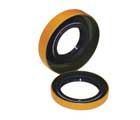
yellow Parker oil seals

Creating a Perfect Oil Seal

A good oil or radial shaft seal is designed to either keep oils or other fluids from leaking out of a mechanical component or to keep contaminants from finding their way in, and many times both.

yellow Parker oil seals

Pumps, mixers, motors, turbines and gear boxes in a variety of industries are susceptible to problems that can be caused by an inadequate sealing system.

To create the perfect oil seal for your equipment, an understanding and an anticipation of the potential damaging factors for your rotary seal are essential.

With the failure of an oil seal, the liquid or gases you are trying to protect could be affected by:

  • An increase of oxidation
  • A decrease in viscosity
  • Unwanted aeration
  • Chemical and physical changes, such as the depletion of additives, increased TAN, sludge or varnish

Your equipment can also be impaired by a failed oil seal by creating:

  • Improper film thickness on the shaft due to excessive lip wear
  • Corrosion
  • Cavities or pits

Determining the best oil seal for your application needs requires a quick review of all installation parameters and operating conditions that will affect the seal including:

  • Shaft finish
  • Shaft speed
  • Internal pressure
  • Operating temperature
  • Fluid compatibility

Leakage can occur at both the seal inside diameter or housing bore diameter.

Static leakage can occur at either.   Leakage occurring at the press-fit at the seal’s outside diameter (OD) can be a result of:

  • the housing bore being too rough
  • damage to the OD during installation (70% of all seal failures are due to cocking during installation)
  • inadequate press fit, due to out-of-range bore tolerance, incorrect seal OD for the bore diameter, or a severely rusted or pitted bore

Leakage at the sealing lip can be caused by damage during installation, shaft condition, or poor internal lubricant draining.

Dynamic leakage normally occurs only at the sealing lip, with damage to the radial shaft seal itself, from poor seal fit, or from operating conditions in excess of those recommended by the manufacturer.

The Seal Specialists at Web Seal can recommend the best sealing solutions for your needs.  We offer more than 700 English and metric Parker and Clipper oil shaft seals for all applications, in sizes ranging from .250” up to 72”.  Traditional metal canned and rubber-coated designs are available along with one-piece bonded seals (typically PTFE-to-elastomer).

We can also help you create any specialty seal design for your specific equipment needs.

Click here for design assistance or to request a quote.